The Sublime, the Beautiful, and the Gothic
n
The Strange Comfort in Being Overwhelmed
The Ruins of Holyrood Chapel, Louis Daguerre, circa 1824, oil on canvas, 211 x 256.5 cm, Collection: Walker Art Gallery, England
There is a particular feeling that has no good name in English, but it has haunted me since my first memories. It can hit me just before a thunderstorm, or in front of a gothic cathedral; sometimes, looking into a wild animal’s eyes. Something inside my soul gets smaller, and something else gets larger at the same time. It is not pleasure only, and it is not fear as well.
The term that approaches this experience the best is the sublime, from the Latin sublīmis — “greatness beyond measure”. Not greatness we can grasp, but one that breaks our own understanding.
Gothic literature is largely built out of this feeling. The ruined abbey, the mountain pass, haunting wilderness, the storm that arrives exactly when the heroine is furthest from home — these are not decoration, but symbols producing a specific emotional state in a reader, and they have a long philosophical history behind it.
So how exactly do The Sublime and The Beautiful work together and suspend us into existence? If we're going back to the beginning, we have to begin where every world does: with words.
With writing.
~
I. Introduction: Greek Origins
Before the sublime was a mountain, it was a sentence. The treatise we call On the Sublime (in Greek, Perì Hýpsous) is traditionally assigned to Longinus, though we know so little about its author that scholars usually call him Pseudo-Longinus. It is a work of literary criticism, probably written in the first century, and it is not concerned with landscapes at all. It is concerned with what happens to a reader when writing works.
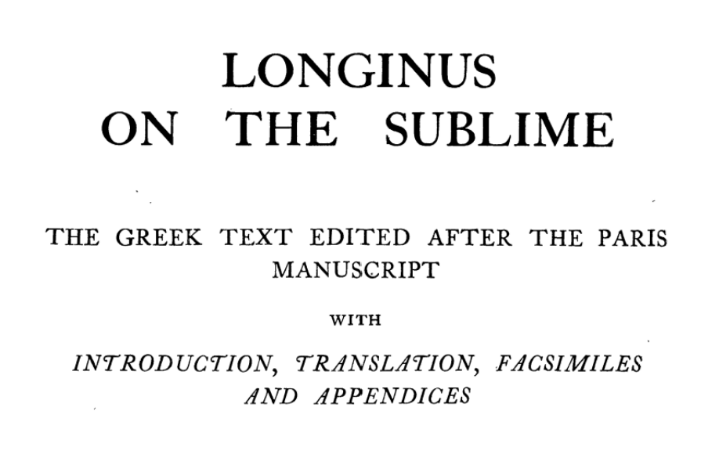
For Longinus the sublime is not a genre and not a subject. It is a quality of elevation — a certain distinction and excellence in composition that raises writing above the ordinary and transports the person receiving it. He describes the effect this way: the true sublime, by some innate power, lifts our souls; we are filled with a proud exaltation and a sense of joy, as though we had ourselves produced what we had only heard:
That last clause is key: the sublime does not merely impress us — it temporarily abolishes the distance between the maker and the receiver.
Longinus is unusually practical about how this is achieved. He names five sources:
Greatness of soul. Sublimity, in his famous formulation, is the echo of greatness of soul. A grand work requires a grand mind behind it. It cannot be faked. He points to masters like Homer, Plato, and the Bible as examples of minds capable of transferring innate high powers into their writing
Passionate emotion. Real, strong feeling — what he calls a kind of divine frenzy — filling the words from inside. Only this genuine passion can contribute to the loftiness of the tone.
Figures of speech. Rhetorical figures must be rooted in genuine emotion and employed in the "right place and the right manner, on the right occasion, and with the right motive”.
Noble diction. Careful choice and arrangement of words, as well as the use of ornamental language. Longinus argues that adopting striking and suitable words at the right moment has a "moving and lasting power" on the reader.
Dignified composition. The elevation of the whole structure, not just the good lines. Sublimity results from a symbiotic relationship between Art and Nature—where Art is perfect when it seems to be nature, and Nature is most effective when it appears to be pervaded by the presence of Art.
The first two can be seen as gifts, while the last three are craft, and the relationship between them is the heart of his aesthetic: the seams must not show. Ultimately, he thought, this is what lifts the human spirit near to the great spirit of God. Longinus was building on ideas that had already existed for centuries. Plato had written about the mysterious power of poetry, while Aristotle had explored what makes a work of art beautiful. Longinus takes these discussions in a different direction by asking what makes literature overwhelming rather than merely beautiful. Homer is Longinus' greatest example of sublime writing.
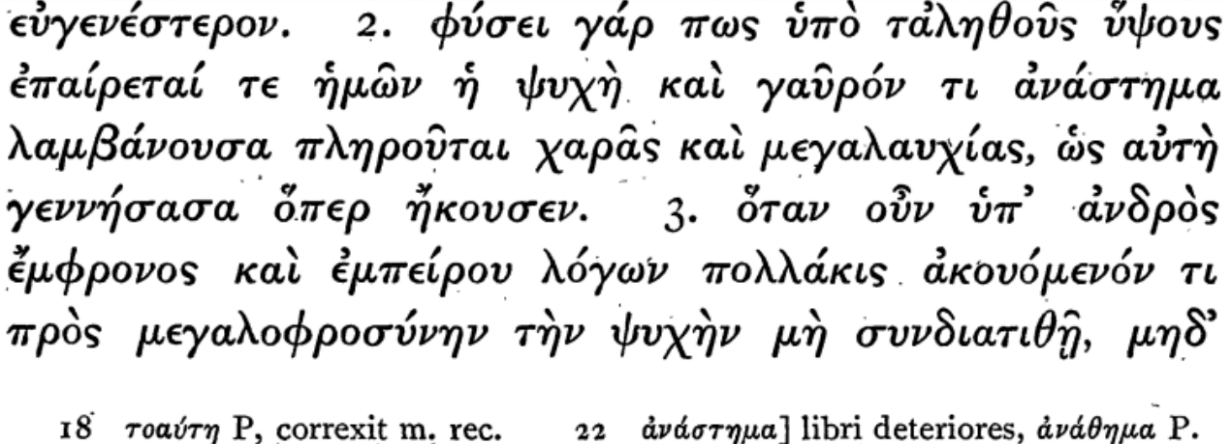
"For by some innate power the true sublime uplifts our souls; we are filled with a proud exaltation and a sense of vaunting joy; just as though we had ourselves produced what we had heard."
- Longinus
Sublime language does not simply persuade the reader—it overwhelms them. One of his most striking examples comes from the opening of Genesis:
"And God said, 'Let there be light,' and there was light."
Here, language does not merely describe reality; it brings it into being. Word and action become one. This is the highest expression of sublime power.
For Longinus, the sublime was not about terror, pity, or fear. Instead, it was a moment of elevation—a feeling that lifts the soul beyond ordinary experience. This is very different from the meaning the sublime would later acquire. The ruined abbeys, violent storms, and pleasurable fear we now associate with the sublime were largely eighteenth-century developments, not Longinus' own ideas. Even so, he briefly mentions the rhetorical power of natural phenomena such as storms, volcanoes, and the sea. Later writers would seize on these examples and transform them into the foundation of a new aesthetic—one centred precisely on the emotions that Longinus himself had excluded.
~
II. The Eighteenth Century: Terror Takes Over
By the eighteenth century, the sublime described experiences that exceeded ordinary understanding. Towering mountains, violent storms, vast oceans, and volcanic eruptions became its defining images. The question was no longer how language could elevate the soul, but why certain landscapes inspired both awe and fear.
The answer came in 1757 with Edmund Burke's A Philosophical Enquiry into the Origin of Our Ideas of the Sublime and Beautiful. Burke transformed the meaning of the sublime by placing terror at its centre. Unlike Longinus, who understood the sublime as spiritual elevation, Burke argued that it originates in our instinct for self-preservation. For him, the sublime overwhelms rather than enlightens. Faced with something immense or threatening, the mind is suspended in astonishment; thought gives way to awe.
Yet this experience becomes pleasurable only because we remain safe. Terror, viewed from a distance, becomes what Burke famously called a "delightful horror." The storm must be watched from shelter; the abyss must have a railing. And this is precisely the experience Gothic fiction creates: the reader is safe, while the heroine is not. That distance transforms fear into aesthetic pleasure rather than genuine danger.
Snow Storm, J. M. W. Turner, 1842, oil on canvas, 91 × 122 cm, Collection: Tate, London, Great Britain
“The passion caused by the great and sublime in nature . . . is Astonishment; and astonishment is that state of the soul, in which all its motions are suspended, with some degree of horror. In this case the mind is so entirely filled with its object, that it cannot entertain any other.”
- Burke, On the Sublime, p. 58
For Burke, there was a sharp distinction between beauty and the sublime. Beauty invites affection, intimacy, and social connection. The sublime arises from danger, solitude, and the instinct to survive. To Burke, these were opposing experiences that could rarely exist together without weakening one another. That conclusion, however, would not remain unchallenged…
~
III. Kant: the Sublime is Not In the Mountain
Immanuel Kant moves the question of the sublime inward.
In Critique of Judgement (1790), Kant agrees with Burke that beauty and the sublime are different experiences, but he changes where they come from. Beauty belongs to form: things that have shape, order, and limits. The sublime appears when we encounter something that seems beyond limits — something too vast, too powerful, or too overwhelming for the senses to fully grasp.
The important shift is this: the sublime is not actually found in the object itself. The mountain is not sublime. The ocean is not sublime. What is sublime is the encounter between the world and the human mind — the moment when our imagination fails to contain something, revealing that reason can reach beyond what we can physically perceive.
Kant divides the sublime into two forms:
The mathematical sublime is the experience of overwhelming size: the endless sky, the vastness of the universe, anything so immense that we cannot take it in as a whole. It is about magnitude.
The dynamic sublime is the experience of overwhelming power: storms, volcanoes, violent seas — forces that could destroy us, but which we observe from a position of safety. It is about force.
Later thinkers explored what this experience feels like from within. Max Dessoir described the sublime as a kind of self-forgetfulness (which is one of my favourite perspectives). In the presence of something greater than ourselves, ordinary fear disappears. We feel small, but that smallness becomes strangely exhilarating. Our sense of limitation becomes the very condition through which we experience greatness. We become small, but that smallness is not a defeat — it is the doorway through which wonder enters.
~
IV. The Gothic: Terror, Horror, Things That Come Back
The Gothic takes this philosophical tradition and turns it into a machine for producing what gothics (or romantics, we can talk about that in another essay) love the most: feeling.
Ann Radcliffe made one of the most important distinctions in Gothic theory in her essay On the Supernatural in Poetry (1826). Terror, she argued, expands the imagination and awakens the mind, while horror does the opposite: it freezes and contracts it. Terror belongs to anticipation; horror belongs to revelation. One is internal, the other is external. Radcliffe's entire method depends on delaying the moment of encounter: the reader must remain at the threshold, because the threshold is where the imagination is most powerful.
This is why Gothic settings carry meaning before anything happens. Ruined castles, abandoned abbeys, and storm-filled landscapes immediately create feelings of uncertainty, isolation, and wonder. The architecture itself begins to perform the work of the sublime.
In The Seven Lamps of Architecture (1849), John Ruskin describes a similar distinction in architecture, separating beauty from power. Beauty comes from harmony, proportion, and forms borrowed from nature. Power comes from scale, weight, darkness, and the physical sensation of being confronted by something greater than yourself. A Gothic cathedral demonstrates this perfectly: the decoration may be beautiful, but the height is overwhelming.
Freud later identified another specifically Gothic experience: the uncanny. The uncanny is not simply the monstrous or unfamiliar. It is the familiar becoming strange — something that should have remained hidden suddenly appearing. A known face in the wrong place. A voice coming from an empty room. Your own home is like a new place for a moment…
Diane Long Hoeveler adds another layer by examining the Gothic's relationship with religion; a lovely, complex topic. She argues that early Gothic fiction emerged during a period when Britain was becoming increasingly secular (and/or Protestant), and that it transformed Catholic imagery — relics, monasteries, rituals, and sacred objects — into sources of fear.
This creates a fascinating contradiction. Gothic fiction often presents the sacred as threatening, yet it also preserves the possibility of mystery in a world increasingly explained through reason. The monastery may be haunted, the relic may be dangerous, but both still suggest that reality contains something beyond the visible and the rational. The monks are villains, but the monastery is still standing. The relic is a threat, but it still works… The sublime, in the Gothic, re-enchants a disenchanted world. It insists — through fear, because fear was the only channel still open — that reality is not exhausted by the material and the rational: it’s a portal for us to go back.
~
V. The Opposition is Artificial
Beauty: form, harmony, limit, pleasure, love, drawing near.
The sublime: formlessness, discord, boundlessness, pain, terror, recoil.
It is a compelling distinction. It is also, I think, incomplete.
Martin Seel argues that the opposition between beauty and the sublime is ultimately too rigid. What captivates us is not whether an experience is ordered or overwhelming, but the movement between the two. Beauty and the sublime depend upon one another. Beauty without any challenge becomes merely decorative; the sublime without any sense of harmony becomes unbearable. Rather than existing as separate categories, they form a tension within the same aesthetic experience.
Once we see this, it becomes visible everywhere in Gothic literature. A ruin is sublime precisely because we know it was once beautiful. Its power comes from the meeting of order and decay, presence and absence, memory and destruction. The same is true in reverse. Beauty untouched by vulnerability rarely moves us deeply. What we call haunting beauty is often beauty carrying the memory of its own fragility. This is why Gothic beauty is always slightly disturbed: the too-pale face, the silent garden, the song heard from an empty house. The beautiful becomes powerful when something threatens to break it.
Aquinas approaches beauty from a different direction, but arrives somewhere surprisingly similar. He identifies three qualities of beauty: integritas (wholeness), consonantia (proportion), and claritas (radiance or clarity). The first two belong naturally to beauty: they describe order, harmony, and completeness. But claritas introduces something more difficult to contain.
Clarity does not simply describe a thing's structure; it describes the way that thing reveals something beyond itself. To be fully seen is almost to shine beyond one's own boundaries. Even within the most orderly account of beauty, there remains a quality that exceeds the frame.
This is the point where beauty and the sublime meet. True beauty does not close itself within perfection. It contains an opening — a place where mystery enters, where the sublime begins.
~
VI. Conclusion: Awe
The Venn diagram is the shape the argument was always moving toward.
On one side: elevation, vastness, terror. On the other: harmony, goodness, grace. And in the overlap, the one word that belongs fully to both: awe.
Awe is what the Gothic is ultimately made of. Not pure horror, which contracts the soul, and not vain beauty, reduced to decoration. Awe is the experience of being diminished and enlarged at once: standing before something too great to contain, and choosing to remain before it anyway.
Longinus believed the sublime lifted us beyond ourselves. Burke believed it overwhelmed the mind. Kant believed it revealed a faculty within us greater than our senses. Radcliffe believed terror could expand the soul. Seel argued that beauty and the sublime were never truly separate. Each thinker approaches the same encounter from a different, but complementary, perspective.
And this is the conclusion I keep returning to, in both poetry and criticism: the sublime is not the opposite of beauty. It is beauty encountered with such intensity that it transforms us. The Gothic has always understood this. Its churches are ruined, its beloveds are lost, and its light enters through broken glass — yet it continues to search for something beyond the visible world.
The Gothic has always been writing about longing. And longing is exactly this: being drawn towards something whose full presence would change you completely, and moving towards it.
The deer does not go to the water only because it is safe. It goes because it is thirsty.
References
Abedini, S. (2022). "Horror and gothic literature, same or separate: A comparative study". International Journal of Health Sciences, 6(S2), 7072–7078.
Aquinas, T. Summa Theologiae, I, q. 39, a. 8.
Bell, J. (2010). "Contemporary Art and the Sublime". The Art of the Sublime, Tate Research Publication.
Burke, E. (1757/1987). A Philosophical Enquiry into the Origin of Our Ideas of the Sublime and Beautiful. Ed. James T. Boulton. Oxford: Blackwell.
Dessoir, M. (1906). Ästhetik und allgemeine Kunstwissenschaft. Stuttgart: Ferdinand Enke.
Foster, S. (2023). "Estranged by a Veil: The Gothic Other and the Uncanny Sublime". Studies in Religion and the Enlightenment, 3(1), 6–20.
Freud, S. (1919/2003). The Uncanny. Trans. David McLintock. London: Penguin.
Ghimire, B. (2022). "Gothic Sublime in Robert Louis Stevenson's The Strange Case of Dr. Jekyll and Mr. Hyde". Journal of Kathmandu BernHardt College, 4, 111–127.
Hoeveler, D. L. (2013). "Demonizing the Catholic Other: Religion and the Secularization Process in Gothic Literature". English Faculty Research and Publications, Marquette University.
Kant, I. (1790/1988). The Critique of Judgement. Trans. James Creed Meredith. Oxford: Clarendon Press.
Landow, G. P. (1971). The Aesthetic and Critical Theories of John Ruskin. Princeton: Princeton University Press.
Longinus (1899). On the Sublime. Trans. W. Rhys Roberts. Cambridge: Cambridge University Press.
Radcliffe, A. (1826). "On the Supernatural in Poetry". New Monthly Magazine, 16(1), 145–152.
Riding, C. and Llewellyn, N. (2009). "British Art and the Sublime". The Art of the Sublime, Tate Research Publication.
Roberts, H. (2023). "Simone Weil and George Herbert on Love through Poetry". French Modern Literary Studies, University of Exeter.
Rosenblum, R. (1961). "The Abstract Sublime". ARTnews, 59(10), 38–41, 56–58.
Ruskin, J. (1849). The Seven Lamps of Architecture. London: Smith, Elder & Co.
Seel, M. (2015). "Beauty: A Brief Conceptual Journey". Aesthetic Investigations, 1(1), 165–173.
Shockley, P. R. "An Introduction to the Aesthetics of St. Thomas Aquinas".
Smith, A. (1994). The Gothic Sublime: A study of the changing function of sublimity in representations of subjectivity in nineteenth-century fantasy fiction. Ph.D. Thesis, University of Southampton.
Taylor, S. (2003). "Mathematics and the Love of God: An Introduction to the Thought of Simone Weil". ACMS Journal.
Thomson, D. H. "Longinus and the Sublime". Department of Literature and Philosophy, Georgia Southern University.
Weil, S. (1951). Waiting for God. Trans. Emma Craufurd. New York: Harper and Row.
Weil, S. (1968). On Science, Necessity, and the Love of God. Trans. Richard Rees. London: Oxford University Press.
Weiskel, T. (1976). The Romantic Sublime: Studies in the Structure and Psychology of Transcendence. Baltimore: Johns Hopkins University Press.
Williams, A. (1995). Art of Darkness: A Poetics of Gothic. Chicago: University of Chicago Press.
Åhlén, E. (2023). "Tantalizing Terrors and Transcendent Thrills: Unveiling the Sublime Aspects in Three Works by Edgar Allan Poe". Stockholm University.
n