The Language of Symbolism
A Foreword
Oedipus the Travel, Gustave Moreau, undated, oil on canvas, 0.93x1.24 m, Musee des Beaux Arts
Very few feelings compare to the joy of being lulled into the flow of story. Compelling images conveyed through the lyricism and dexterity of language is enough to drive one to learn as many as possible, as if collecting instruments. Languages can be learnt by sheer exposure, a route that has many benefits, but the other common ladder available combines practice with active study of the structure and patterns of that language: its grammar, vocabulary, and lexical nuances.
The beauty and magnetism of certain images produce their own music, and avid consumption of paintings and carvings and films is by no means an unpleasant task when learning to produce new ones. However, rarely do we think of such images as a language in a sense other than metaphorical. Very confrontingly, then, do previously hidden meanings surface with jolting clarity when the same deconstruction of language is applied to visual symbolism.
Without needing to force a linguistic structure onto visual symbolism, there are often very similar, naturally occurring patterns: a type of grammar and vocabulary can be clearly seen, as well as parts of speech like metonyms and contranyms (visual symbolism often relies on opposites). Just as there are different languages and dialects within speech, so there are analogous visual systems within symbolism, emerging in different regions with sub variations – all nevertheless containing clear patterns. While there will always be some part of the meaning behind these images that remains incomprehensible – this is often what keeps us returning to great paintings – analysing the linguistic patterns within images and seeking to translate their meaning with this framework can be one of the most rewarding and revealing pursuits when learning about art.
The Symbolic Word
As with language, symbolism has words, phrases, sentences and stories.
What then does a symbolic word look like?
'Foot Study' after G. Hater, Emmanuelle Capatos, 2024, Graphite and Chalk on Hand-toned Paper, 21×23cm, Private Collection
Consider the human foot. This is a symbolic word, a fragmentary image usually combined with others to make a full thought.
Symbolically, feet represent the will or intention of the heart (while hands represent action), the etymological roots being the idea that the intention guides action, as feet carry us in the direction they point in.
Where then, is the foot a key motif?
Biblically, the image first appears in the third chapter of Genesis. Following the first sin of man, humans are cursed with the snake that will strike at their heel. Temptation has now and onwards pierced the will of man.
Later in the Old Testament, Deuteronomy and Leviticus state that the requirements for a ‘clean animal’ is that it must 1) chew its cud (not be carnivorous), and 2) have split hooves. In other words, no clean animal had feet designed to walk on soft ground, and the separation between humans and the animals that did not set their feet on a firm foundation became law. To set one’s feet on solid ground then becomes a core biblical metaphor to mean stabalising one’s intention on a solid moral foundation.
Psalm 40:2 reads:
"He lifted me out of the pit of despair, out of the mud and the mire. He set my feet on solid ground and steadied me as I walked along."
In the New Testament, during a scene between Peter and Jesus, the washing of the feet motif appears with an added explanation. Upon Jesus undertaking the service of washing the disciples feet, Peter protests that the Son of God should not stoop to so humble a task. Jesus responds that in order for Peter to get into the Kingdom of Heaven, Christ must first wash his feet.
“Then, Lord,” Simon Peter replied, “not just my feet but my hands and my head as well!” (John 13:9)
to which Jesus responds that washing his feet, and only his feet, is necessary to make him clean. This scene is the symbolic action of the teachings Jesus has been repeating throughout: that righteousness does not come from purity of action, but purity of intention. Heaven is not a place for those who are sinless – indeed, ‘among you none are sinless’ – but those with an earnest and pure intention to serve the highest.
In mythology, it is no random coincidence that despite the countless variations within each Greek myth, the foot motif surfaces in this way again and again.
Achilles, a god-like hero, falls at the nick of his heel. When studying such a prolific story, it is valuable to question why a more vulnerable part of the human body was not intuitively used as the weak point in a hero, like the neck or eyes. Wounds to the heel are seldom fatal. And yet, it becomes clear that the meaning signified with this image is that a great and competent character may collapse if a flawed will is their foundation.
Similarly, in Greek and Berber myth, Antaeus could not be defeated in a wrestling match unless his feet were lifted off the ground, and Oedipus famously had an injured heel at infancy. In myth, the injured foot is a sign of a doomed fate.
Even now, it is not by chance that the phrase ‘to get cold feet’ as a last minute loss of courage is still used in multiple languages. Its origin is debated, but it was popularized by gamblers withdrawing from the poker table supposedly due to cold feet in the late 19th century.
Détail "Oedipe et le Sphinx", carton, Gustave Moreau, Paris, musée Gustave Moreau
Oedipus and the Sphinx, Gustave Moreau, 1864, Oil on canvas, 206.4 × 104.8 cm, The Met
The Symbolic Phrase
Given this example of a pattern that exists as a symbolic word, that of the foot representing the will of man, what then does a symbolic phrase look like?
Combined with another symbolic word, the thorn, we get one of the most prolific images in art history: spinario, an image of a boy folded over at the waist, fully concentrating on removing a thorn from his foot.
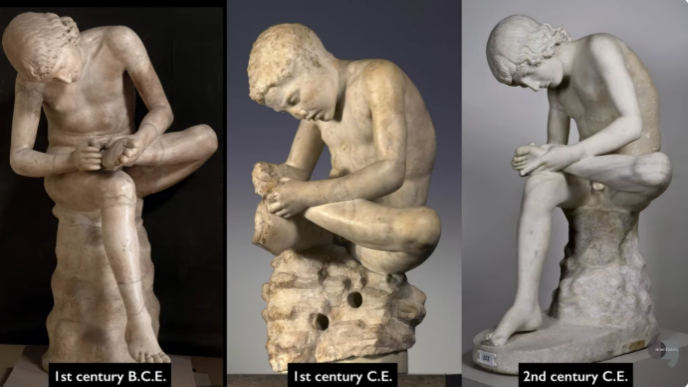
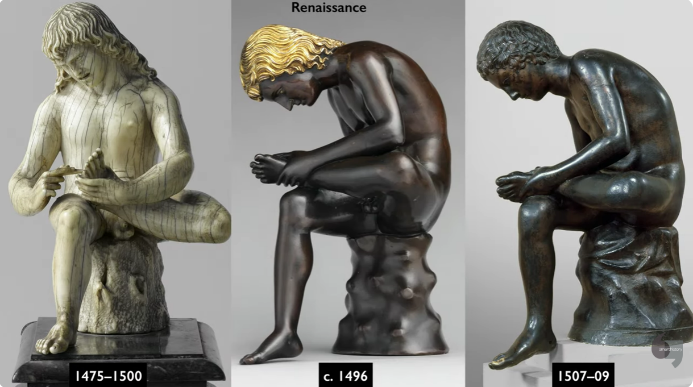
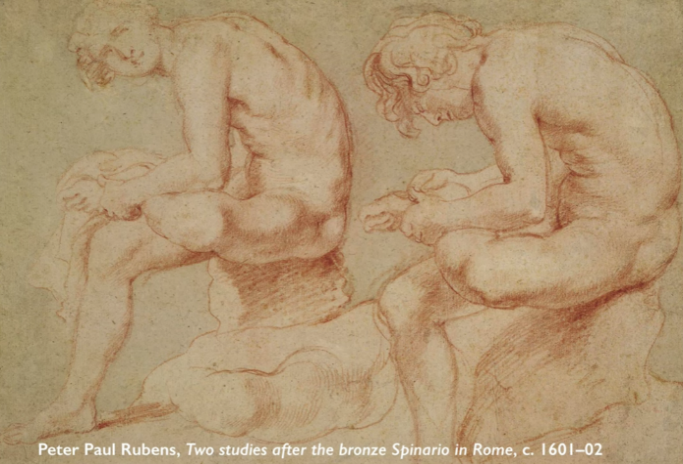
Smarthistory. (n.d.). A moment in time that’s lasted 2000 years— the Spinario (boy pulling a thorn from his foot) [Video]. YouTube. https://www.youtube.com/watch?v=aRd_ad_LvR4
Part of the motivation to understand the language of symbolism is to help us understand why we look at the same images again and again. Patterns are, by nature, not random. And this image appears repeatedly throughout the centuries, in bronze and marble and ivory, in etchings and sketches and paintings. What meaning then, seemingly relevant to countless people across culture and centuries, lies within it?
The thorn exists as the symbolic word for sin (most notably, Christ wears a crown of thorns during his crucifixion as the sign that he had ‘become sin for us’). In spinario, the thorn is so minute, that it is never actually depicted. The symbolic phrase created by the boy and the thorn is that if one’s will is weakened by even the smallest flaw, all progression must stop and all attention must be given to remedying it.
The Symbolic Story
Building upon this image, we come across Brunelleschi's Competition Panel of baptistery doors competition in Florence in 1401.
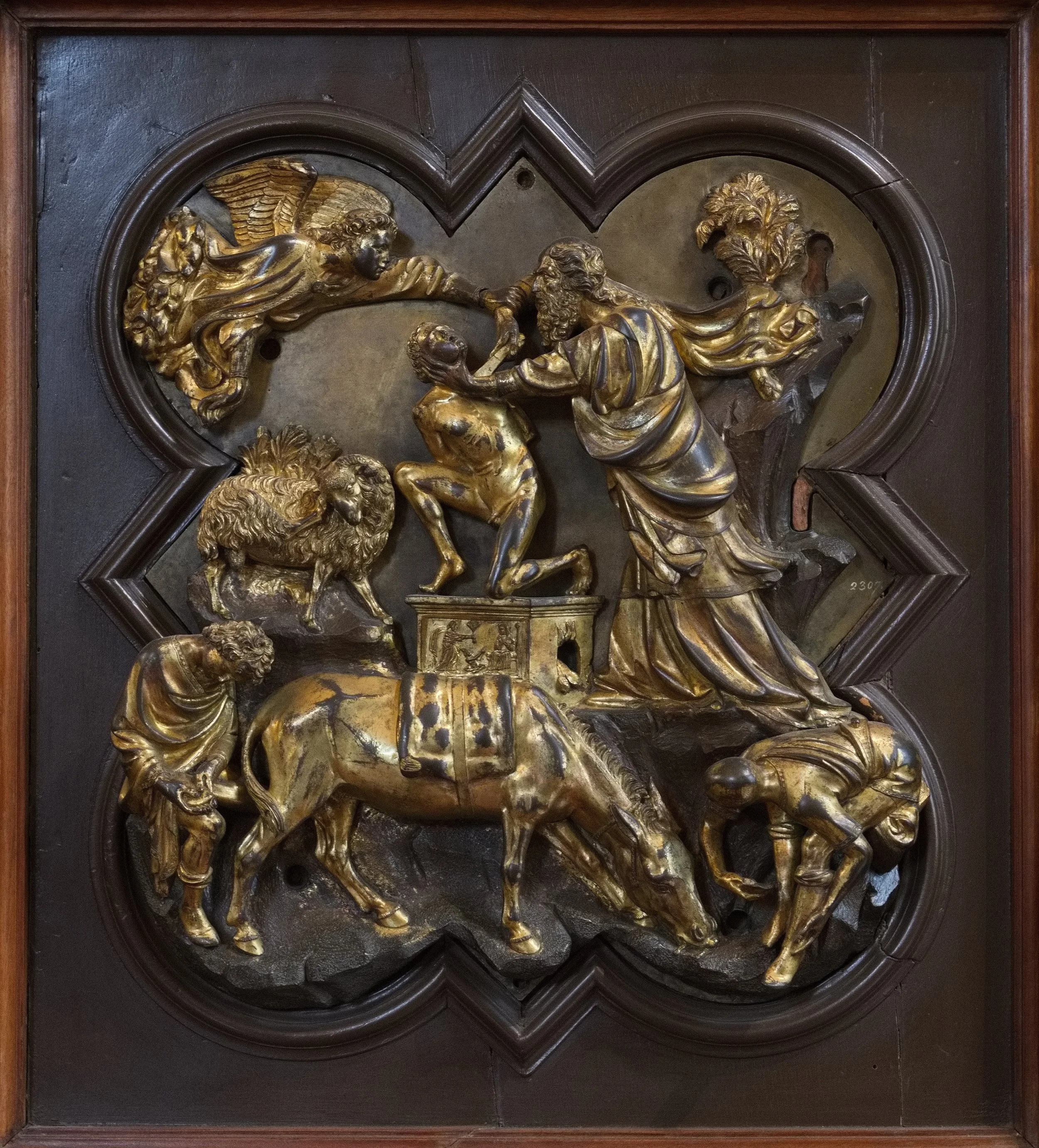
The Sacrifice of Isaac, Filippo Brunelleschi, 1401-2, gilded bronze relief, 45 x 38 cm, Bargello, Florence
The panel depicts the Sacrifice of Isaac, and there in the lower left corner, a servant of Abraham sits unaware, plucking a thorn from his foot in the iconic spinario pose.
To dismiss the formal qualities that spinario lends this composition is by no means the purpose of this argument. Spinario was favoured here as a reference to classical antiquity and the numerous roman sculptures Brunelleschi studied. Additionally, it was included in such a way as to create flowing rhythms that lead the eye back to the central figures of Abraham and Isaac. Whether or not he had intentionally included it for its deeper meaning fortifies the fact that images often carry a psychological significance, regardless of whether the artist is conscious of it or not.
And when we look at other examples, this lens helps up understand the greater complexity that ageless stories carry: what moral blind spot led Achilles to meet his downfall? What flaw led Oedipus to his inevitable fate?
A Deeper Language
The existence of linguistic patterns with visual symbolism is a compelling argument. However, there is a significant difference between spoken languages and this concept.
Symbolism is, of course, closer in structure to sign languages than spoken, in that there is a spatial grammar instead of a linear one[1]. Regardless, even in sign language the gesture for ‘gate’ is different in British Sign Language versus American Sign versus Japanese Sign, etc. And in spoken languages, very rarely are there documentations of the same word being independently used to describe the same object; false cognates, words without shared etymology roots, almost never occur[2].
In contrast, there is an apparent universality to the symbolic language, across space and time. This may be owed either to their shockingly contagious nature when travel and trade served to transmit them, or to a potentially even more fascinating explanation: their independent emergence as symbolic ideas. The Great Flood story exists in mythologies of ancient Sumera, Babylon, China, Peru, India, the Americas, Italy, and not least the book of Genesis. They all involve some variation of a wise man who is warned of a great flood, who builds a boat (often to save his wife, family, and animals in many of the tales, though not all), lands on a mountain, and witnesses a sign in the sky after the flood subsides. While this may seem to be a prolific story originating from a single source, the Sumerian and Biblical accounts, for example, have been confirmed to have arisen independently.
It is also not as simple as dismissively attributing the universality of these symbols to similar environmental circumstances. Various symbols of the snake appear in cultures lacking native snakes, including Ireland, New Zealand, and Iceland. One of the most ancient and universal symbols, the ouroborus, shows a snake biting its tail. This is extremely rare in nature.
Finally, few languages remain as unchanged as certain symbols. The written and spoken word evolve continuously, and dramatically enough that a thousand years of separation render the words of our predecessors completely alien to us. Some symbols, on the other hand, seem to persist with remarkable stability. For instance, medical associations in Asia, India, Canada, Great Britain, France, Germany, Africa, and Scandinavia all share the Staff of Aesculapius, the ancient Greek symbol of medicine, as their symbol[3]. Sphinxes filled paintings and stories throughout the 19th century with similar symbolic meanings to their ancient counterparts.
This is only a foreword: a door prised open but a little. Beyond it, the beauty, gravity, and strange endurance of symbolic form reveal a language older and more profound than these few examples can illustrate. Symbolism exists in many ways as a consciously observed system, but simultaneously speaks to a far more fundamental mode of communication that powerfully articulates human understanding and experience. Symbols are arguably the most effective carriers for the stories and ideas that shape the human soul, and as such call for investigation into how and why they come to be. In our pursuit of art, we should pay attention to the weight they hold, and let their recurring forms lead us deeper into the truths they have carried across centuries.
[1]In British sign language, for example, ‘the gate is in front of the house’ is indicated by gesturing the sign for ‘gate’ and then moving your hands back in space to sign ‘house’ behind where gate was signed.
[2] ‘Mama’ and ‘papa’ in infancy tend to be the most cross-cultural words, partly owing to their easy pronunciation during development. Another false cognate example occurs in English and an extinct Australian aboriginal language, which both use the same word for ‘dog’, pronounced and spelt identically. (This made for some comical confusion in the translation process.)
[3] Many organizations mistakenly use the caduceus staff used by Hermes, two snakes encircling a pole with wings, as their logo. This began in 1902, when it was adopted as the emblem for the US Army medical officer uniform. Instead of medicine, Hermes typically represents commerce, negotiation, and alchemy.